
Did you know that small-space cooling options now use up to 40% less energy than traditional units? In 2026, five standout devices blend portability, low power, and quiet operation—from USB-powered desktops to compact evaporative coolers—so you can stay comfortable without a full-sized setup. You’ll want to compare features like tank size, humidity options, and noise levels to pick the right fit for your desk, dorm, or camper, but there’s more to the story beyond specs.
Key Points
- Personal evaporative coolers offer efficient, low-power cooling for small spaces without refrigerants, ideal for desks, dorms, and bedside areas.
- Look for units with 550–1300 mL tanks and removable reservoirs to balance run time with convenient refills.
- USB-powered options (5V, 8–12W) enable flexible power from power banks, laptops, or car adapters for portable use.
- Multi-mode devices with fan, mist, and LED lighting provide targeted cooling, humidity, and ambiance in compact rooms.
- Prioritize models with quiet operation, replaceable cartridges or filters, and at least a 1-year warranty for reliable support.
Evasmart Portable Evaporative Cooler for Desk/Camping
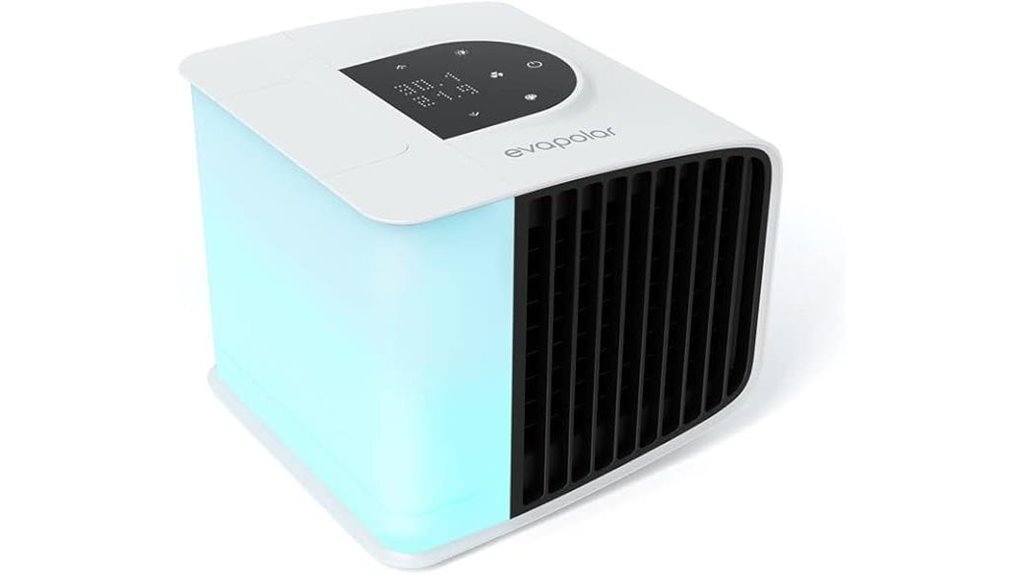
If you need a portable, energy-efficient solution for personal cooling, the Evapolar evaSMART is hard to beat—it’s a 3-in-1 device that both cools and humidifies your immediate space using evaporative technology, with a 44 oz water tank and USB-C power for desk, camping, or travel setups. You’ll get natural, personal cooling within 3–5 feet, no Freon, and a temperature drop from evaporation. It runs at about 12.5W, quiet up to 40 dB, and taps USB power from banks, laptops, or car outlets. Lightweight, replaceable cartridge, 1300 mL reservoir, and 37 sq ft reach support portable comfort anywhere.
Best For: Those seeking a portable, energy-efficient personal cooling solution for desks, camping, travel, or small spaces, especially in dry climates.
Pros:
- Energy-efficient operation at ~12.5W with USB-C power, reducing energy use compared to traditional AC units.
- Portable and quiet (up to ~40 dB), lightweight with a 1300 mL reservoir and 44 oz tank for on-the-go cooling.
- 3-in-1 functionality (cooling, humidifying, and lighting) with a replaceable cartridge and easy USB-powered setup.
Cons:
- Effective cooling is localized to a personal space (3–5 feet) and may not cool larger rooms.
- Performance depends on dry climate conditions; evaporative cooling is less efficient in high-humidity environments.
- Limited water reservoir and battery/USB power options may require frequent refills during extended use.
ChillWell 2.0 Evaporative Cooler with Humidifier
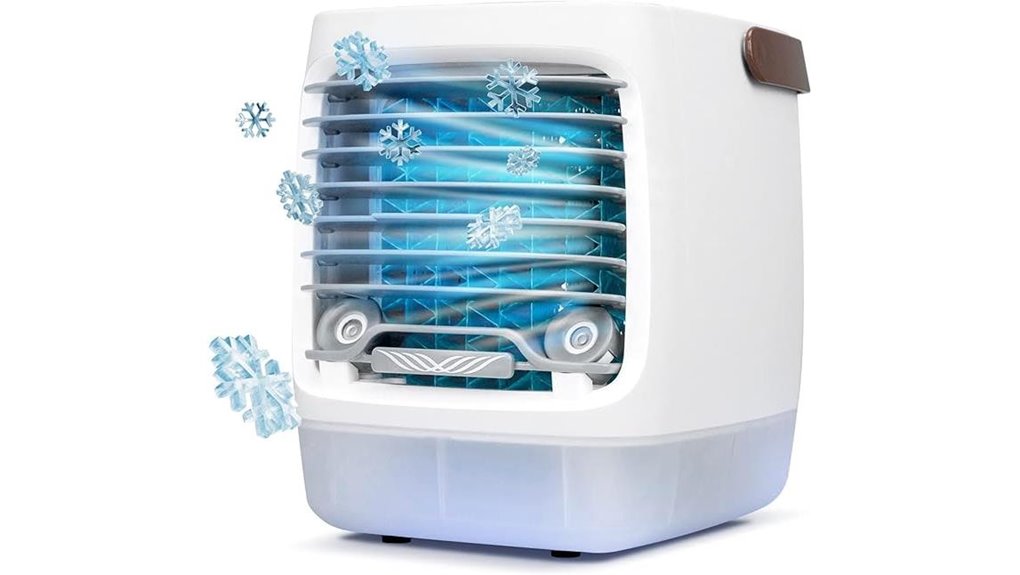
The ChillWell 2.0 Evaporative Cooler with Humidifier stands out for compact, energy-efficient cooling that suits small spaces. You get Insta-Frost Technology delivering ice-cold air to cool you down and regulate humidity. This combo unit blends evaporative cooling with a humidifier for breeze plus balanced humidity. It pulls in hot air, transforms it into refreshing mist for instant relief. It’s energy-efficient versus traditional portable ACs, with minimal electricity use. Ready to use out of the box—unbox, insert cartridge, plug in, and cool in seconds. A 550ml reservoir fuels longer cycles, up to 8 hours plugged in. Low-noise, portable, customizable airflow.
Best For: Individuals in small indoor spaces (like bedrooms and home offices) seeking energy-efficient, quiet cooling with humidity control and portable, all-in-one humidifier features.
Pros:
- Compact, portable design ideal for desks, nightstands, and small rooms
- Energy-efficient alternative to traditional portable AC units
- Combines evaporative cooling with a humidifier for balanced humidity and comfort
Cons:
- May be less effective in very dry or very large spaces
- Requires a water reservoir refill (up to 550ml) for extended use
- Perceived cooling depends on ambient humidity and airflow availability
3-in-1 Portable AC with USB Power, 5V Adapter Included
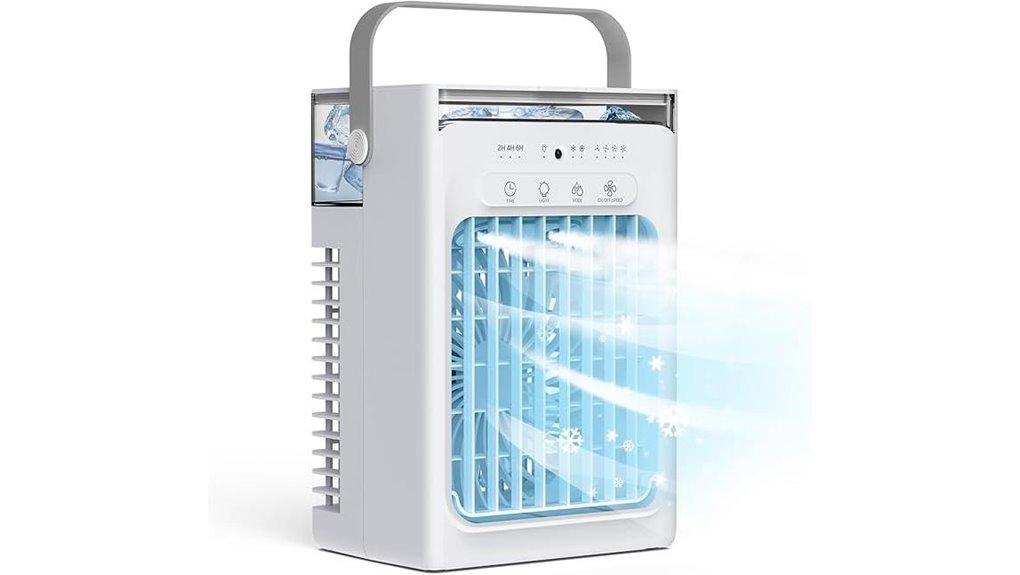
For compact rooms where USB power is all you’ve got, this 3-in-1 portable AC stands out with its USB-powered design and 5V adapter included, making it ideal for dorms, desks, or small offices—no special outlet required. You get a combined fan, humidifier, and evaporative cooler in one compact unit, with mist modes for humidity and extra cooling when you add cold water or ice. Direct airflow with 70° louvers and 4 speeds lets you tailor comfort. A 1000ML tank runs 6–8 hours, while a quiet 6-blade fan and timer keep evenings and workdays untroubled. Remote, RGB lighting, and portability round out the package.
Best For: Dorm residents, students, and small-space workers who need USB-powered cooling with built-in humidification and portable convenience.
Pros:
- USB-powered with 5V adapter included for flexible power options (laptop, power bank, car charger, wall adapter)
- 3-in-1 functionality (fan, humidifier, evaporative cooler) with 1000ML tank for up to 6–8 hours of use
- Quiet operation with 6-blade fan and adjustable 70° louvers plus remote control and RGB ambient lighting
Cons:
- Cooling effectiveness depends on adding cold water or ice; may be less potent in very hot environments
- Requires access to USB power; not ideal for outlets-only setups without USB options
- Large tank may require regular refilling and cleaning, and weight may affect portability when full
Arctic Air Pure Chill 2.0 Evaporative Cooler – Blue
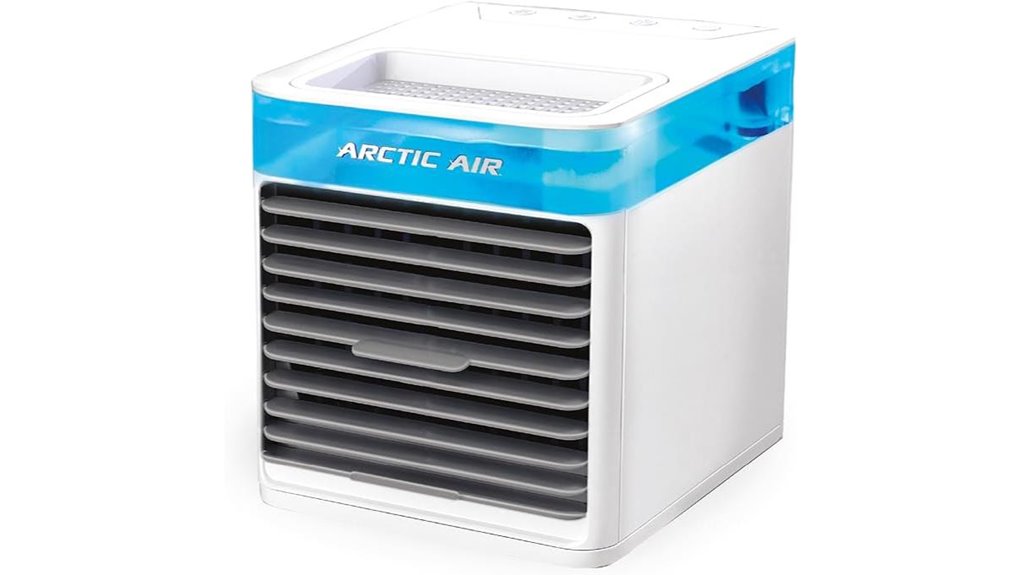
Compact and portable, the Arctic Air Pure Chill 2.0 Evaporative Cooler shines for small spaces thanks to its Hydro-Chill Technology and dual cooling jets that quietly cool and humidify the surrounding air. You power it with 120 volts and enjoy low energy use, about 8-10 watts, for up to 10 hours depending on speed, room temp, and humidity. Its space-saving, lightweight design fits a desk, nightstand, or counter and moves easily around the house. Use the top-fill tank and touch controls with four speeds, plus a built-in LED nightlight with 7 colors for ambient comfort. Ideal for bedrooms, offices, and living areas.
Best For: Busy individuals seeking portable, energy-efficient personal cooling for small spaces like desks, nightstands, and counters.
Pros:
- Compact and lightweight design for easy portability
- Low energy consumption (8-10 watts) and up to 10 hours of operation
- Dual cooling jets and Humidity-increasing Vapor-Chill for targeted cooling
Cons:
- Best suited for small spaces; limited airflow for larger rooms
- Requires periodic refilling of the water tank
- Evaporative cooling effectiveness depends on room humidity and temperature
Portable Mini Air Cooler with LED Lights and Timer
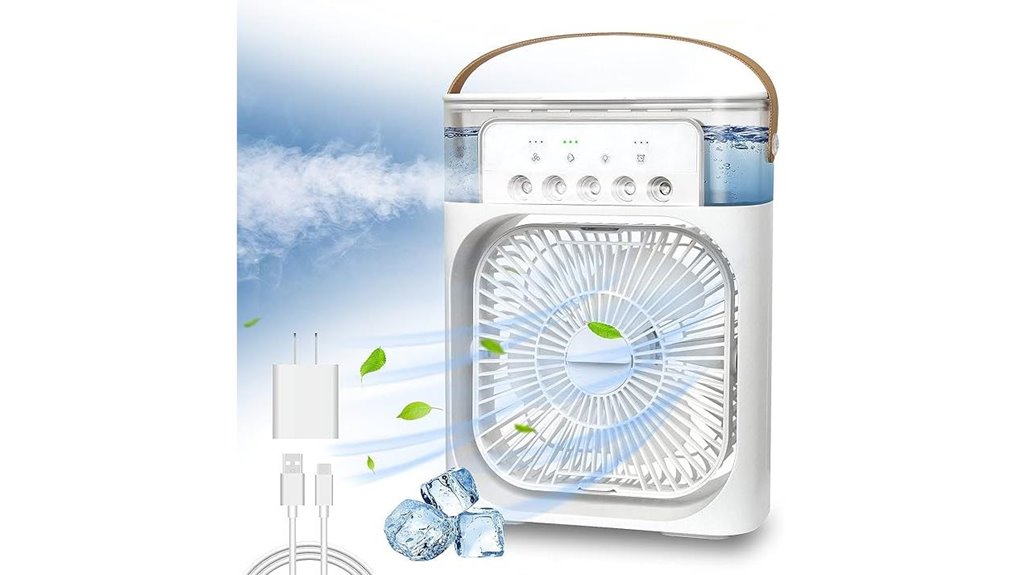
This Portable Mini Air Cooler with LED Lights and Timer is the best pick if you want personal cooling with low energy use and added ambiance, thanks to its 7-color LED lights and multiple timers. You get a portable evaporative cooler with a 600 ml reservoir, USB power, and 10W draw, so it’s cheaper to run than a Freon unit. Choose from 3 speeds, 3 spray modes, and 3 timers (1H, 2H, 3H) for sleep or work. The removable tank supports water or ice, with a 60-degree vertical range and a quiet operation for comfortable use anywhere. Model AF-001-Old.
Best For: This portable mini air cooler is ideal for individuals seeking personal cooling with low energy use, ambient LED lighting, and adjustable misting for desks, bedrooms, or small spaces.
Pros:
- Low energy consumption (10W, USB-powered) and cheaper to run than traditional air conditioners
- Portable with a removable 600 ml tank that supports water or ice and adjustable 60-degree vertical direction
- Versatile features: 3 speeds, 3 spray modes, 3 timers (1H, 2H, 3H), and 7-color LED lights for ambiance
Cons:
- Small personal unit not suitable as a room-wide cooling solution
- Water reservoir capacity requires periodic refilling for extended use; may need frequent attention in hot conditions
- Not a replacement for Freon air conditioners; effectiveness depends on evaporative cooling and ambient humidity
Factors to Consider When Choosing Cooling Device for Small Spaces
When you pick a cooling device for a small space, start by matching its size to your area so it fits without crowding your layout. Check power needs, available ports, and how you’ll refill water or empty the tank, since these affect setup and run-time. Consider the cooling method, water tank capacity, and how loud it gets, so you know it won’t disrupt daily use.
Size And Space Fit
Is size really the only thing that matters when choosing a cooling device for a small space? No. You should match footprint, weight, and capacity to your setup. Personal or compact units typically cool about 37 square feet or less, which fits desks, tents, and tiny rooms. An 8–10 inch footprint keeps the unit unobtrusive, often weighing 0.4–4+ pounds, so it lands neatly on a desk or bedside table. Tank capacity around 550–1300 milliliters determines refill frequency in compact areas, helping you plan without surprises. Look for noise levels under 40 dB to avoid distraction. Adjustable airflow directions and multi-speed or mist options let you tailor cooling to tight spaces without overwhelming the room. Choose portable, space-conscious design aligned with your specific spot.
Power And Ports
Power and ports determine how you’ll power a compact cooler and where you’ll place it. Many portable evaporative coolers run on USB power or low-voltage adapters (5V USB, about 8–12W), so you can use power banks, laptops, or car chargers. Rechargeable models add hours of operation, typically 4–8 hours depending on tank fill and mode, boosting portability in tight spaces. Reservoirs vary from 550–1300 mL, which directly affects run time and cooling duration since larger tanks reduce refills. Some units include dedicated power adapters (5V USB-C) or 120V mains, shaping where you can operate them—desk, car, bed, or outdoor spots. Many offer remote control or app-based tweaks to optimize power use, speeds, and modes for energy-efficient cooling.
Cooling Method
Choosing the right cooling method starts with how you want to move air and moisture in a small space. If you want simple, refrigerant-free cooling, consider evaporative options that lower air temperature by evaporating water. They work best in dry climates and compact, personal spaces, delivering localized comfort without harsh energy use. Personal evaporative units typically run at low power—about 8–12 W—and use a water reservoir to provide cooling within 3–5 feet. Some models blend cooling with humidification, adding moisture to improve comfort where air is dry. You can boost performance with ice or cold water on certain units, often via a “Turbo” mode. Multi-mode devices may include fan, mist, and LED features, offering adjustable airflow and humidity for targeted small-space relief.
Water Tank Capacity
Water tank capacity directly determines how long a cooling cycle can run before refills are needed. If you choose a larger tank, you’ll enjoy extended misting periods between fills and fewer interruptions. Capacities in typical examples range from 550 ml to 1300 ml, affecting runtime and how often you top up. A bigger reservoir supports longer continuous operation at a given mist or fan setting, reducing pauses for water refills. Refill practicality depends on the unit’s evaporation rate and chosen mode, since higher cooling or mist settings consume water faster. Look for removable or wide-mouth tanks to simplify refilling and cleaning, helping maintain consistent performance and hygiene between uses. This factor directly influences convenience and reliability in compact spaces.
Noise Levels
When you’re cooling a small space, quiet operation matters as much as effective airflow. Noise levels for compact coolers usually sit around 39–40 dB on low settings, so you get whisper-quiet personal use. Many units offer multiple speeds, with the lowest setting designed to minimize noise while delivering gentle airflow. In general, larger water tanks or mist modes can marginally raise noise versus fan-only modes, so consider your tolerance for a touch more sound if you need stronger cooling. Built-in LED lighting and night-light features add convenience but stay mostly quiet. Remote control or app-based adjustments help you fine‑tune speed and mist levels to keep noise low in quiet environments.
Humidity Control
Humidity control matters in small spaces, especially when evaporative cooling adds moisture to the air. In dry environments, evaporation helps, but in humid rooms it can worsen the dampness. Look for units that pair cooling with a humidifier function to balance humidity while cooling. A larger water reservoir supports longer humidification cycles, reducing refills during extended use. Adjustable mist or spray modes let you control the humidity increase, from light to high moistening. Noise-friendly operation often accompanies humidity features, so seek models with quiet fans, LED night lights, and multiple speed or mist settings for comfortable, controlled humidity. Consider whether you need features like auto shutoff or timers to maintain stable moisture levels without constant monitoring.
Portability And Weight
You’ll want a cooling device that’s easy to move and fits neatly on a desk or shelf, so prioritize portability and light weight. Most models are designed for portability, weighing roughly 0.375 kg to about 1.8 kg (4 pounds) at most, making movement simple between spots. Compact dimensions are common, typically around 8–9 inches in width or depth with a similar height, so they occupy minimal surface area on desks or small surfaces. USB-powered options add even more flexibility, letting you run cooling from power banks or laptops for on-the-go use. Built-in handles or ergonomic shapes further simplify relocation, while light to moderate noise levels (around 39–40 dB) keep disruption to a minimum in compact environments. Prioritize lightweight, compact, and easily transferable designs to optimize small-space cooling.
Longevity And Warranty
Longevity and warranty are your safety net when picking a cooling device for small spaces. Start with at least a 1-year manufacturer warranty to cover defects and performance dips, and confirm it includes both parts and labor, not just replacements. Check how long the coverage lasts and the claims process—online registration, proof of purchase, and return authorization should be straightforward. Look for devices with replaceable essential components like cartridges or filters, so you can extend usable life without a full replacement. Also review Amazon’s return policy and any vendor support channels so you know where to turn for troubleshooting after you buy. A solid warranty and accessible support can save you time, money, and frustration if issues arise.
Common Questions
How Loud Are These Small-Space Cooling Devices at Night?
They’re usually quiet enough for night use, but it varies. Look for models labeled as “sleep mode” or under 40 dB, and check independent reviews for real-world noise. You’ll notice a soft hum near your pillow, or a whisper-quiet, steady breeze that won’t wake you. If you’re sensitive, prefer inverter compressors or ceramic/heating elements with low-frequency brightness. Run tests during daytime, then decide based on your actual sleep comfort.
Do They Work Well in High Humidity Environments?
Yes, they can work well in high humidity, though effectiveness varies by type. About 60% of portable air conditioners remove humidity well enough for comfort in humid rooms, while dehumidifiers excel at moisture control even without cooling. If you have sauna-like humidity, combine a dehumidifier with a modest fan or AC. Look for models with humidistat and energy-star ratings. You’ll notice steadier temps and less stickiness when humidity stays lower.
What Running Costs Should I Expect Monthly?
Expect monthly running costs to range about $15–$70, depending on device type, usage hours, and local electricity rates. A compact portable AC or dehumidifier uses more electricity than a fan or evaporative cooler. You’ll save by using programmable timers, sealing gaps, and leveraging natural cooling at night. Track your meter for a couple of weeks to estimate real costs, then adjust settings, insulation, and airflow to keep bills reasonable.
Can They Double as Heaters in Cold Weather?
They can, but it’s tricky. Some portable air conditioners and heat pumps offer both cooling and heating, yet they don’t excel at both tasks in extreme temps. In mild shoulder seasons they’ll keep you comfy, and you’ll save space. If you need reliable warmth, you’ll want a dedicated heater or a unit with a true auxiliary heat option. Check energy labels, and ensure proper venting and sizing for your space.
Are Replacement Parts Readily Available Locally?
Yes, replacement parts are usually readily available locally. Start by checking the manufacturer’s website for local distributors, then call nearby appliance or electronics repair shops to confirm stock. Bring your model number and serial if possible. If parts aren’t on hand, ask about ETA and whether they offer in-store pickup or home delivery. Consider joining a local repair club or online marketplace listings to speed up sourcing. Always confirm compatible part numbers before purchasing.