
If you’re chasing cool without breaking the bank in 2026, these cheap alternatives to portable ACs are worthconsidering. You’ll find options like compact evaporative and 4-in-1 units that sip power and offer quiet operation, plus USB fans and misting humidifiers for desks and small spaces. But not every model stacks up on runtime or tank size, so you’ll want to weigh mist adjustment, sleep modes, and noise before you commit. Curious which setup fits your space best?
Key Points
- Consider evaporative or USB-powered mini units for energy-efficient, budget-friendly cooling at desks, bedrooms, or small spaces.
- Look for units with large tanks (700–1500 mL) and multiple mist/fan settings to extend run time between refills.
- Prioritize ultra-quiet designs (sleep mode around 50–55 dB) for comfortable use during work or sleep.
- Choose compact, portable models with rechargeable or USB power for mobility without outdoor units.
- Evaluate overall value by balancing features (LED lights, remote, timers) against size, weight, and energy use.
4-in-1 Portable Air Cooler with LED Lights
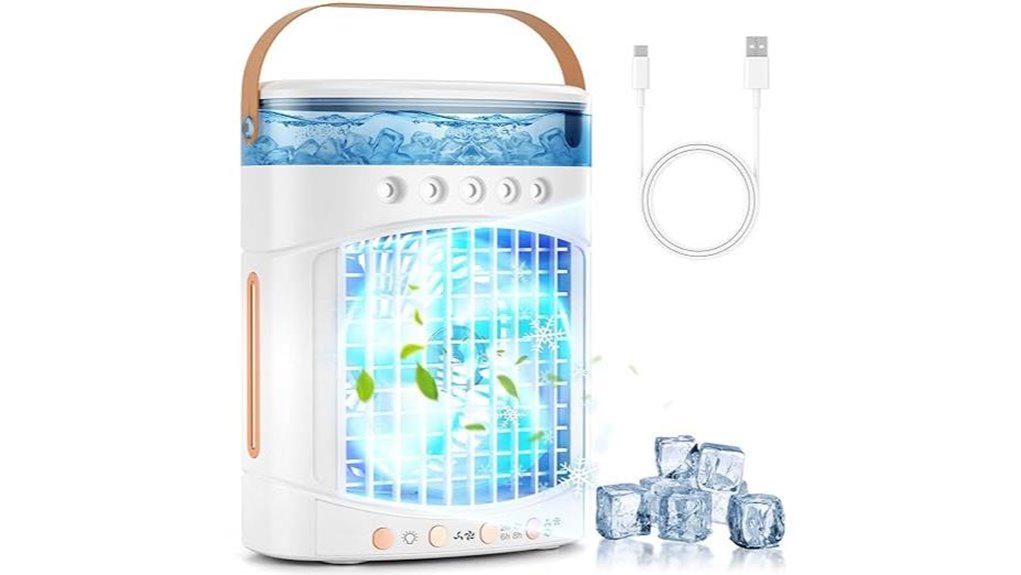
If you want a compact, budget-friendly cooler that doubles as a humidifier and nightlight, this 4-in-1 unit from Gcobup fits the bill. You get a portable 4-in-1 device: air cooler, humidifier, fan, and nightlight, with a 700 mL reservoir and auto dry-off protection. It offers 2 fan speeds, 3 mist levels, and 7-color LED lights for ambience, operating quietly at about 55 dB. USB-powered and lightweight, it’s ideal for home, office, camping, or car use, though it’s plug-in only. Add ice for stronger cooling, and enjoy simple controls and up to 6–8 hours of continuous use.
Best For: Budget-conscious users seeking a compact, multi-function cooler that also acts as a humidifier, fan, and nightlight for desks, bedrooms, cars, or camping trips.
Pros:
- 4-in-1 functionality in a compact, lightweight unit
- USB-powered for versatile power options (power banks, adapters, car chargers)
- Quiet operation and optional ice for enhanced cooling
Cons:
- Plug-in only with no built-in battery
- 700 mL tank may require more frequent refills for extended use
- Mixed customer reviews (average around 2.9/5) and potential variability in performance
Portable 4-in-1 Ultra-Quiet Portable AC with Remote
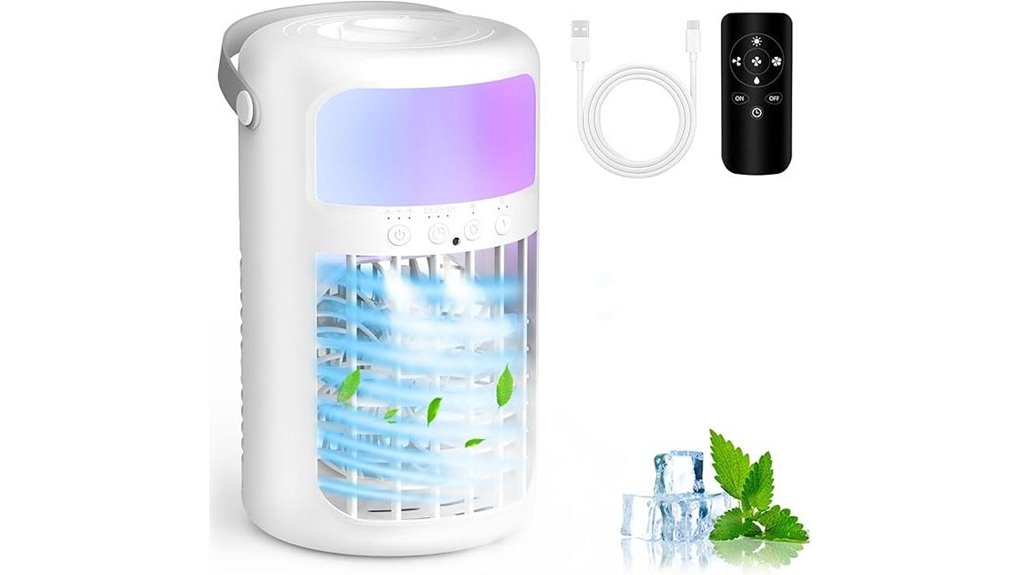
This 4-in-1 Ultra-Quiet Portable AC with Remote stands out for budget-conscious users who want a single device that chills, humidifies, and vibe-light, plus a quiet night’s sleep. You get a 2025 upgraded 4-in-1 design: portable AC, humidifier, fan, and a 7-color night light in one compact unit. Choose from 3 fan speeds and 2 mist modes, with a 1500ml tank delivering up to 8 hours of continuous mist. It runs quietly thanks to evaporative cooling tech and offers 1H/3H/6H timers. Airflow tilts 90° for precise direction, and a remote lets you control everything from distance. USB-powered and portable for indoors or outdoors.
Best For: Budget-conscious users who want a single, compact device that chills, humidifies, and adds ambient lighting for home, office, or outdoor use.
Pros:
- 4-in-1 convenience (AC, humidifier, fan, 7-color night light) in one compact unit
- Large 1500ml water tank supports up to 8 hours of mist for continuous humidity
- Quiet evaporative cooling with adjustable 3 fan speeds, 2 mist modes, and 90° airflow
Cons:
- USB-powered and adapter not included; requires power source and may limit long-range use
- May be less effective for very large rooms without supplemental cooling
- Requires regular water refills for extended use and ongoing misting
Arctic Air Pure Chill 2.0 Evaporative Cooler, Blue
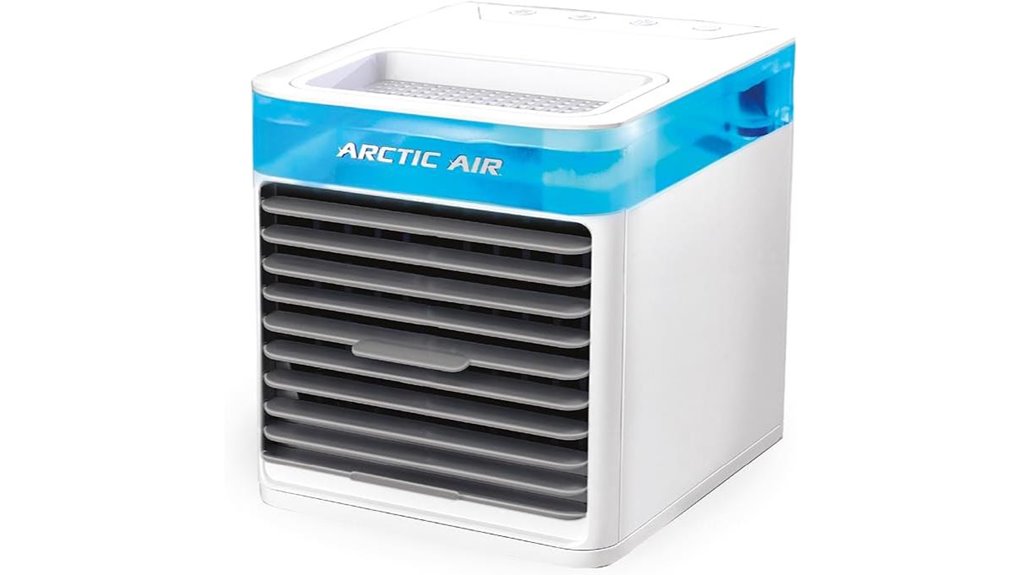
The Arctic Air Pure Chill 2.0 Evaporative Cooler stands out for personal, portable cooling with ultra-low energy use, drawing just 8-10 watts to run up to 10 hours. You plug it in, fill the top tank, and enjoy instant cooling with four speed settings. This compact unit uses Hydro-Chill Technology to cool and humidify the surrounding air, turning a humid day more tolerable. It’s 120 volts and ultra-light, so you can move it from desk to nightstand or kitchen counter. With multi-directional vents and an LED nightlight, it fits bedrooms, offices, and small living areas—easy to use, simple to refill.
Best For: Best For individuals seeking a compact, energy-efficient personal cooler for desks, nightstands, or small living spaces where portable cooling and gentle humidity are desired.
Pros:
- Ultra-low energy consumption (8-10 watts) with up to 10 hours of run time
- Compact, portable design with multi-directional vents and built-in LED nightlight
- Easy to use with top-fill tank and four speed settings
Cons:
- Water-based cooling requires periodic refilling (every ~10 hours depending on use)
- May provide limited cooling in larger rooms or very hot, dry environments
- Humidity level is modest; not a replacement for a full-room air conditioner
Midea 10,000 BTU Portable AC with AIR Dehumidifier
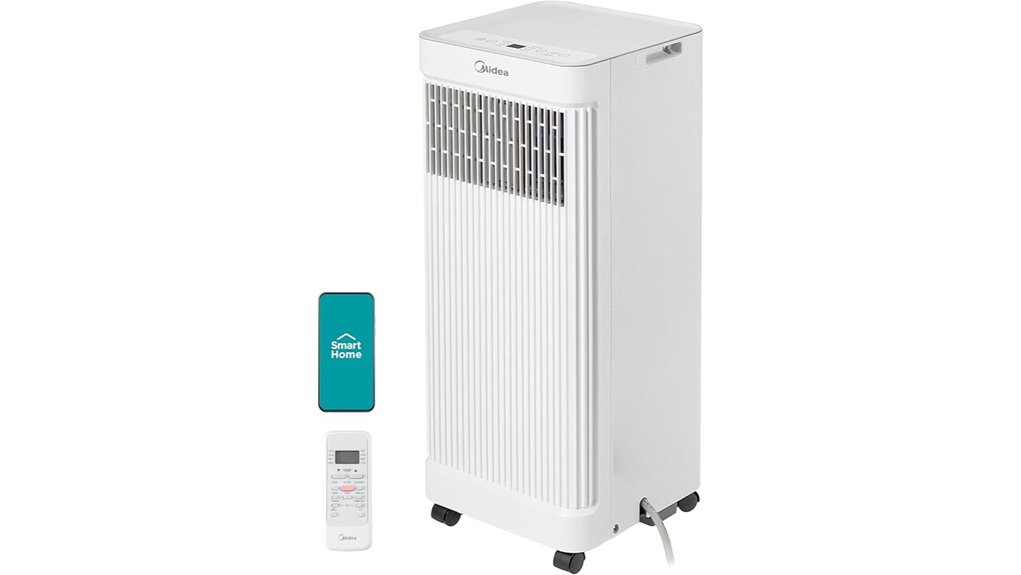
The Midea 10,000 BTU portable AC with AIR Dehumidifier stands out for delivering 3-in-1 flexibility in a compact unit, cooling up to 300 sq. ft. while also acting as a dehumidifier and fan. You get ASHRAE 10,000 BTU (7100 SACC) cooling, plus dehumidification and fan modes. Use the 24-hour timer, digital controls, and LED display, with the remote or SmartHome app for iOS/Android, plus Alexa and Google Assistant support. Setup is simple: roll it into place, attach the 5 ft exhaust hose, and window brackets fit 26.5–48 inches. Includes filter, window kit, and hoses; one-year warranty.
Best For: Homeowners or renters needing a portable, all-in-one cooling, dehumidifying, and fan solution for rooms up to 300 sq. ft., with smart app and voice control.
Pros:
- 3-in-1 functionality (cooling, dehumidifying, and fan) in a single unit
- Smart features: WiFi app control and voice assistant compatibility (Alexa/Google)
- Easy setup with included window kit and hoses; lightweight enough to roll to desired area
Cons:
- 1010 watts power draw; may be less energy-efficient than some inverter models
- 50 lb unit could be cumbersome to move frequently
- No inverter compressor; relies on reciprocating compressor which may be noisier and less efficient at certain loads
EUHOMY 8000 Btu Portable AC with Remote
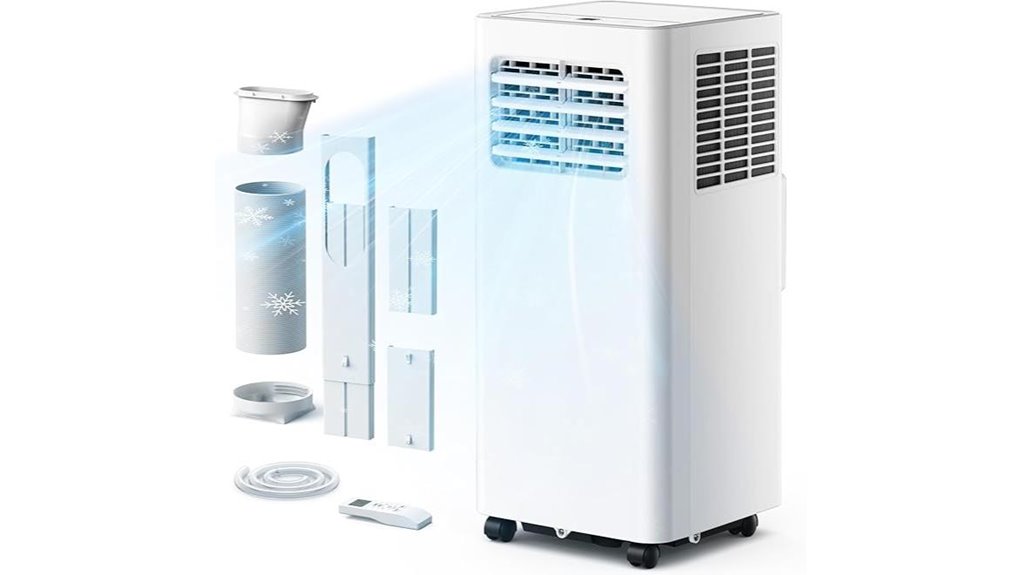
If you’re after a compact, all-in-one cooling option for small spaces, the EUHOMY 8000 BTU Portable AC stands out with its four-mode comfort system (cool, dry, fan, and sleep) and a dehumidifier that handles up to 86 pints per day, making it a solid pick for bedrooms or apartments up to 350 sq ft. This model delivers 8,000 BTU (ASHRAE) cooling, 50 dB noise in Sleep mode, and a 24-hour timer. It uses R-32 refrigerant, includes a window kit, remote, and washable filter, and operates at 110V with 770W power for simple, portable cooling.
Best For: Bedroom, apartment, or small-office environments up to 350 sq ft seeking a compact, all-in-one portable AC with dehumidification and multiple modes.
Pros:
- All-in-one 4-mode system (Cool, Dry, Fan, Sleep) with dehumidifier up to 86 pints/day
- Quiet operation in Sleep mode at about 50 dB and 24-hour timer for scheduling
- Portable, no outdoor unit required, includes window kit and remote for easy setup
Cons:
- 8,000 BTU (ASHRAE) may be borderline for very hot, high-load spaces exceeding 350 sq ft
- 770W power draw; may be higher than some compact units and affect electricity usage
- No inverter; relies on rotary scroll compressor, which can influence efficiency at varying conditions
Factors to Consider When Choosing Cheap Alternatives to Portable AC
When you’re weighing cheap alternatives to portable AC, start with budget-friendly cooling options and how they balance upfront cost with running expenses. Consider power needs, portability, tank capacity or run time, and how noise or comfort levels might affect daily use. Weigh features against size to get the best value for your space, aiming for the right mix of performance, convenience, and affordability.
Budget-Friendly Cooling Options
Looking for cheap ways to beat heat without a big AC investment? Consider budget-friendly cooling options that fit small budgets and modest needs. Evaporative coolers run on water evaporation, ideal for hot-dry climates, and sip relatively low power—about 8–10 watts—much less than traditional portable units. Some budget designs pair cooling with humidification, night lighting, and fans, packed into compact 10–14 inch footprints, with run times tied to water reservoirs (roughly 700–1500 ml). USB-powered models offer flexibility for power sources like banks or adapters but need constant power and usually deliver limited cooling. For more coverage, note that large portable ACs (8,000–10,000 BTU) cool up to ~350 sq ft, but they’re heavier, louder, and pricier. Compare run time, tank size, noise (around 50–55 dB), and installation needs.
Power and Portability
Power and portability go hand in hand when you’re picking cheap cooling options. USB-powered mini units let you run from power banks or laptops, offering real mobility but they often lack built-in batteries, so you’ll rely on a steady power source. If you want longer operation between refills or cycles, consider models with larger water or refrigerant capacity—like bigger tanks or higher BTU ratings—yet know that increases weight and reduces true portability. Energy use matters: evaporative coolers pull roughly 8–10 watts, while portable ACs demand more, trimming battery life or travel power availability. Weight and dimensions matter too: compact humidifier-style units stay under 1 kg, whereas room-scale portable ACs can weigh 40–50 pounds. Wireless remotes help distant placement but add minor power needs.
Tank Capacity and Run Time
Tank capacity mostly dictates how long a cheap cooling unit keeps running between refills. Larger tanks, like 1500 mL, can sustain misting for up to about 8 hours, while smaller tanks (around 700 mL) typically offer 6–8 hours. Run time also hinges on settings: higher fan speeds and mist levels burn through water faster, shortening refill intervals. Ice or cooling aids can extend perceived cooling, but they still rely on water volume; adding ice boosts chill without changing capacity. Refilling frequency depends on room conditions (temperature, humidity) and device design, with water-based systems needing periodic top-offs. Portable units with built-in larger tanks and efficient mist mechanisms generally deliver longer runtimes than compact models with smaller reservoirs.
Noise and Comfort Levels
When choosing a cheap portable cooling alternative, noise and comfort matter as much as raw power. Noise level matters for your daily use, with units typically around 50 dB in sleep mode and 55–60 dB in standard operation. Look for models that advertise ultra-quiet, sleep, or night modes to cut disturbance during rest or work. Lower fan speeds and mist modes help reduce decibels without sacrificing cooling, aiding a calmer space. Real-world sound varies with room temp and humidity, since higher fan or pump demand can raise noise slightly. A unit’s stated decibel rating is a solid benchmark for comfort, but your sense of noise depends on space and placement. Use these ratings to compare how each unit fits your environment.
Features Versus Size Value
Features matter, but size often drives value just as much as spec sheets. When you weigh features, don’t assume more modes or a bigger tank automatically mean better value. A unit with cooling, humidification, fan, and light can still feel bulky or heavy for its output, reducing portability. Likewise, larger water tanks (around 1500 ml) extend run time but add weight and dimensions, making it harder to move between rooms. Multimode units with sleep timers and remotes are convenient, yet they may raise upfront cost without boosting small-space cooling. In tight setups, compact units with 7-color LEDs or adjustable 90° airflow can feel worth it, even with lower BTU. Balance energy use and runtime claims against space to judge if extra features justify the form factor.
Common Questions
How Do Noise Levels Compare Across Cheap Alternatives?
When you hear the whisper of a fan, you’ll notice noise varies by model. Cheaper units often hum louder than midrange options, but many stay tolerable at low speeds. Evaporative models run quieter still, since they lack compressors. Portable pad systems can creak a bit, yet some use brushless fans that cut noise. Expect around 40–60 dB for quiet modes, 60–70 dB on high, and occasional peaks beyond for inexpensive units.
Do These Units Require Professional Installation?
No, most of these units don’t require professional installation. You’ll typically follow the included setup guide, install any exhaust kit or panels, and plug the device into a standard outlet. Some window models need a simple bracket or seal, but you can usually do it yourself. If you hit airtight gaps or risky electrical steps, pause and consult a pro. Otherwise, you’re fine handling it with the manual.
Can They Lower Humidity Without a Dehumidifier?
You’ll be glad to know they can lower humidity a bit, but not as effectively as a dehumidifier. One interesting stat: most affordable units reduce humidity by roughly 5–15% in a typical room. You’ll still feel drier with a stand-alone dehumidifier or a unit with humidity control features. For best results, pair the device with ventilation, keep doors closed, and monitor moisture levels to avoid mold.
Are Replacement Parts Readily Available and Affordable?
Replacement parts are generally available and affordable for most popular portable AC brands, especially through authorized dealers and online marketplaces. You’ll find filters, hoses, fans, and control boards at reasonable prices, plus DIY tutorials to save on labor. If you’re shopping, verify model numbers and warranty terms so replacements stay cheap and easy to source. Keep spare filters on hand and check compatibility before buying to avoid mismatches or higher repair costs.
What Is the Typical Monthly Operating Cost?
The typical monthly operating cost varies, but most affordable alternatives run about $10–$20 in electricity per month, depending on usage and climate. If you’re cooling a small space, you might spend around $5–$15; larger rooms could hit $20–$30. On average, expect a 20–50% drop versus central AC. You can save more by using fans strategically, sealing gaps, and setting moderate temperatures. Monitor your bill to tailor usage to your needs.