
You might think small rooms can’t stay cool, but the right air cooler can quietly tighten your comfort without clutter. In 2026, you’ll find compact, energy-smart 4-in-1 models with mist, night-light, timers, and easy-fill tanks, all under 80W and with USB options for desks. Curious how to pick the best fit for your space and budget without sacrificing performance? Let’s explore the top picks and what matters most.
Key Points
- Prioritize compact, lightweight designs with built-in handles and small footprints for desks, nightstands, or tight spaces.
- Look for 80W or less power usage, with energy-efficient operation and timers to save energy.
- Favor models with adjustable 60° (or more) oscillation and directional airflow to target small areas.
- Choose units with clear water level indicators, easy-fill tanks, and washable filters for low-maintenance use.
- Ensure remote control, multiple mist/fan speeds, and quiet operation (under 60 dB) for unobtrusive cooling.
Portable Mini Air Conditioner with Remote, 3 Speeds, 3 Mist, Timer
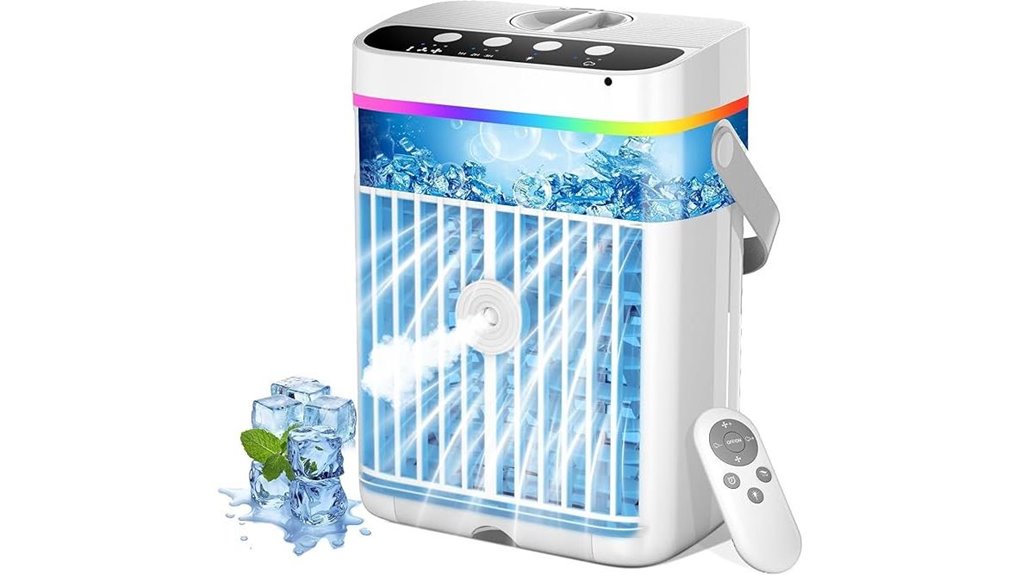
If you’re shopping for a compact option that doesn’t skimp on features, this Portable Mini Air Conditioner with Remote stands out with its all-in-one design: a cooling fan, humidifier, LED night light, and timer in one compact unit, plus remote control for easy operation from across the room. You get three cooling speeds (Low, Mid, High) and three mist levels, plus seven color night lights to set the mood. It’s USB-powered, compatible with power banks or laptops, and suitable for bedrooms, living rooms, offices, or outdoors. A 1250 ml tank runs 8–9 hours, with a leak-proof bottom outlet and adjustable 60° airflow.
Best For: People who want an all-in-one, compact cooling solution with adjustable mist, lighting, and remote control for use at home or outdoors.
Pros:
- Multi-functional device combines cooling fan, humidifier, LED night light, and timer in one unit.
- USB-powered with wide compatibility (power banks, laptops, adapters, car chargers) for versatile use.
- Large 1250 ml tank offers long operation (8–9 hours) with leak-proof design and adjustable 60° airflow.
Cons:
- May be less effective as a primary cooling solution in very hot environments due to its compact size.
- Light and mist features could require frequent refilling for extended use in hot conditions.
- Noise level not specified; potential for audible operation at higher cooling speeds.
Arctic Air Turbo Chill Evaporative Cooler with LED
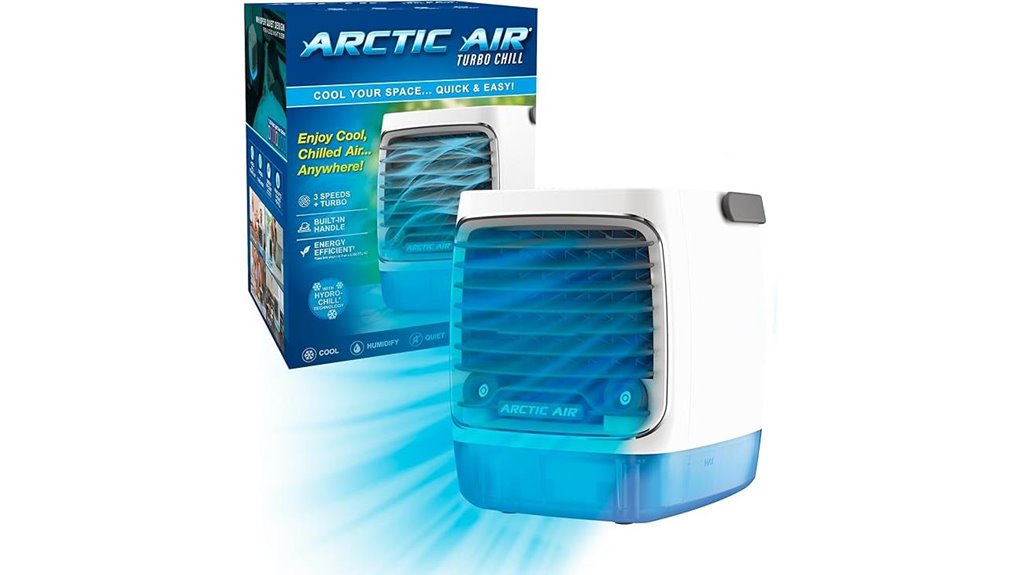
The Arctic Air Turbo Chill Evaporative Cooler with LED stands out for anyone needing a compact, all-in-one cooling and humidifying solution in a tiny space. You get HydroChill cooling with four speeds—Low, Medium, High, Turbo—and mist control for adjustable comfort. A 7-color LED night light adds ambience, while a built-in handle and compact footprint make it portable between rooms. Expect wide-angle oscillation and an adjustable grill for directed airflow, plus ETL-listed, energy-efficient operation. It runs up to about 8 hours per fill, humidifies as it cools, and shows water level at a quick-view window for easy maintenance. Indoor use only.
Best For: Individuals seeking a compact, portable cooling and humidifying solution for small personal spaces like bedrooms, offices, dorms, or desks.
Pros:
- Compact, portable design with a built-in handle and lightweight construction
- HydroChill evaporative cooling with four speeds and mist control for adjustable comfort
- Humidifies air while cooling and features a 7-color LED night light
Cons:
- Indoor use only; not suitable for larger rooms or whole-home cooling
- Run time and effectiveness depend on room temperature and humidity
- Requires ongoing water top-ups and regular monitoring via the quick-view window
Portable Personal Air Conditioner with Mist, LED, Timer
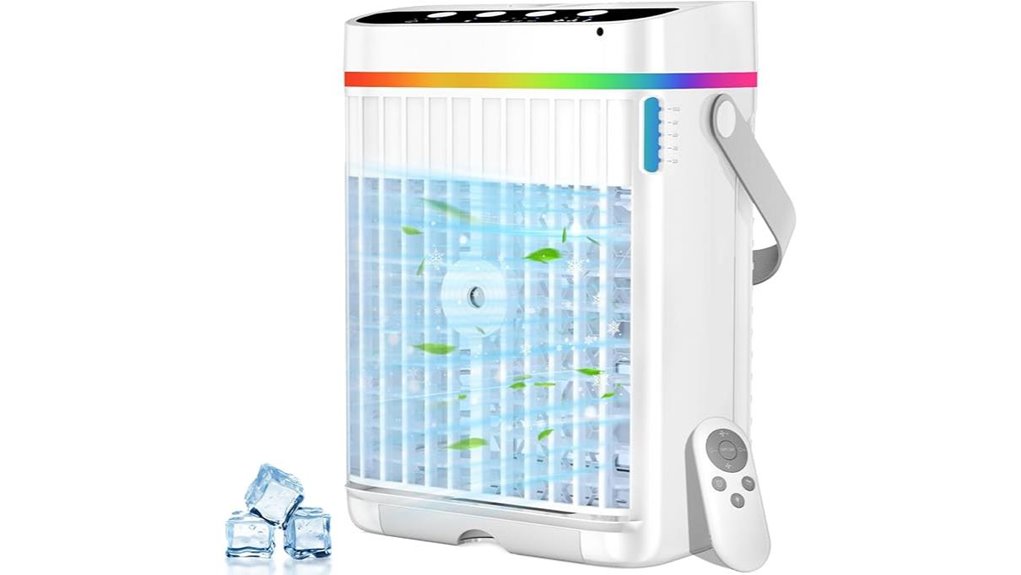
This Portable Personal Air Conditioner with Mist, LED, and Timer suits anyone seeking compact cooling with customizable mist and mood lighting. You get a high-performance motor and air-duct, plus 3 mist humidification modes for cooling airflow. Choose from 3 wind speeds and 3 cooling mist levels, with 120° adjustable wind direction. It lowers surrounding temperatures to 68–60°F; add ice cubes or cold water for stronger chill. A 40 oz tank runs up to 10 hours on a single fill. Enjoy 7-color ambient lights and sleep timer options (1H, 2H, 3H) for automatic shutoff. USB charging keeps it portable.
Best For: Individuals seeking portable, customizable personal cooling with mist, mood lighting, and USB-powered operation in compact form.
Pros:
- Compact, lightweight design with portable top handle and USB charging compatibility.
- Three mist humidification modes and three wind speeds with 120° adjustable direction for customizable comfort.
- Large 40 oz tank offering up to 10 hours of operation on a single fill and 7-color ambient lighting.
Cons:
- Distilled water not recommended; mineral or tap water required, which may affect performance over time.
- Ice cubes or cold water needed for stronger chill, adding prep steps for maximum cooling.
- Adapter for USB power not included; requires external power source for operation.
Portable 4-in-1 Air Cooler with Remote and Humidifier
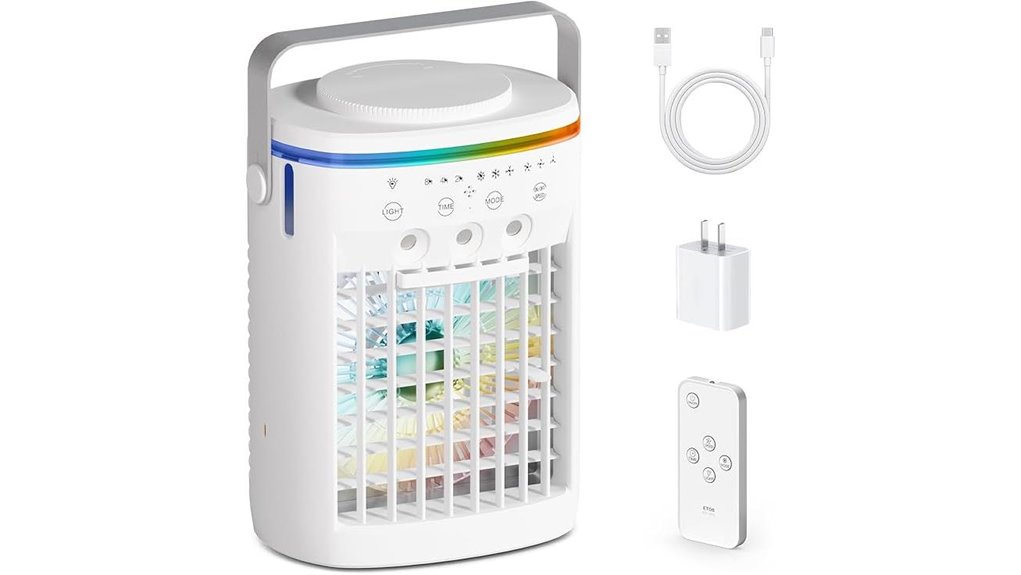
Compact, portable, and multi-functional, this 4-in-1 air cooler combines cooling, humidifying, a nightlight, and a fan in one small device, making it ideal for personal comfort in tiny rooms. You get a 1000 ml water tank with an open design for easy water or ice addition and simple cleaning. No exposed blades keep kids and pets safe, and the compact 7.7 x 5.4 x 10.1 inches form fits desks or nightstands, with a carry handle for portability. Choose from high/medium/low speeds and spray levels, plus remote control, USB-C power, and a 2/4/8 hour timer.
Best For: persons seeking a compact, multi-functional personal cooler that also humidifies, provides a soft nightlight, and operates quietly on a desk, nightstand, or small living space.
Pros:
- 4-in-1 functionality (cooling fan, humidifier, nightlight, and fan) in a compact form factor
- 1000 ml water tank with open design for easy refills and cleaning; no exposed blades for safety
- Remote control, USB-C power, and adjustable timer (2/4/8 hours) for convenience
Cons:
- Designed for personal cooling only; not intended to cool an entire room
- Requires a USB-C power source with current over 2A for optimal performance
- May require frequent water refilling in hotter conditions due to the 1000 ml tank size
SereneLife Evaporative Tower Cooler with Remote
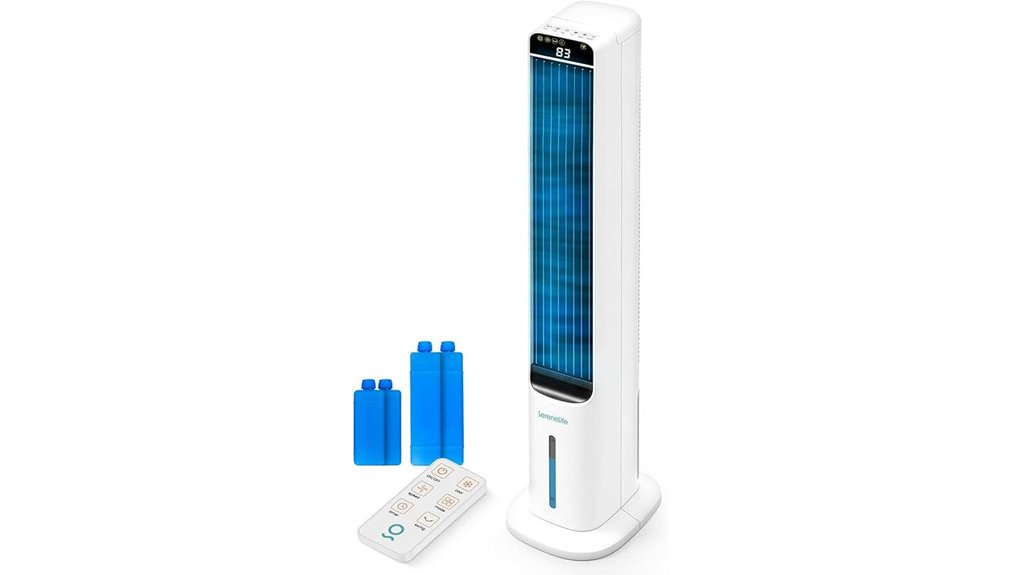
Looking for a portable, energy-efficient option that keeps a warm room comfortable without loud AC? The SereneLife Evaporative Tower Cooler with Remote delivers revitalizing airflow for indoor spaces. It uses a 5L detachable tank and four reusable ice boxes to boost cooling, with a washable dust filter for cleaner air. Enjoy 60° oscillation, three speeds, and three modes—Normal, Natural, and Sleep—controlled by a top panel or remote. At 80W, it remains energy-efficient and quiet (under 60 dB). Its 1000 m³/h airflow suits dry, warm environments, making it ideal for small rooms, dorms, or offices. Portable, compact, and versatile.
Best For: Anyone seeking an energy-efficient, portable cooling solution for small to mid-sized rooms, dorms, or offices without the noise and high cost of traditional AC.
Pros:
- Low energy consumption (80W) and quiet operation (under 60 dB)
- Flexible cooling options with 3 speeds and 3 modes plus 60° oscillation
- Uses 5L detachable tank with 4 reusable ice boxes and a washable dust filter for cleaner air
Cons:
- Evaporative cooling effectiveness depends on dry climates with higher humidity reducing performance
- 1000 m³/h airflow may be modest for larger rooms or open layouts
- Requires regular ice box/tank maintenance and refilling for optimal cooling
Factors to Consider When Choosing Air Cooler for Tiny Room
When you pick an air cooler for a tiny room, start by matching its cooling capacity to the space and ensuring the size fits your footprint. Look for energy efficiency, low noise levels, and maintenance simplicity so you’re not chasing frequent refills or repairs. Consider how easy it is to use daily and how well it handles room size, power use, and long-term upkeep.
Cooling Capacity Match
To match a tiny room, choose a personal or desk cooler with a focused airflow instead of a full-room model. For cooling capacity, prioritize compact units with a personal cooling scope and low CFM, so you don’t overwhelm the space. Look for models labeled “personal” or “desk,” and ensure the airflow isn’t overpowering; enough to feel but not blast. Check run-time per fill or battery options to match your short-use needs in small areas. Prefer adjustable directional airflow, so you can target a specific spot up or down, or swivel to follow your seating. Consider mist or humidification levels in relation to room humidity to avoid moisture buildup. Match capacity to the area’s size, not just wattage, for efficient comfort.
Room Size Fit
In tiny rooms, your goal is a compact unit that delivers focused, deskside cooling rather than a full-room blast. Choose a model with a small footprint and light design so you can place it without crowding your space. Favor personal cooling features over whole-room power to prevent overpowering the room. Check fan speeds and mist or evaporative settings; lower speeds and adjustable directional airflow let you tailor comfort without overcooling a tiny area. Look for a built-in water reservoir or easy-fill tank that fits your refill rhythm, with a clear water level indicator for quick checks. Prefer units offering 60° or adjustable oscillation to direct airflow to your immediate area, avoiding unnecessary cooling of the whole room.
Energy Efficiency
Energy efficiency matters more in tiny rooms, where every watt counts and the unit’s operation should feel barely noticeable. When evaluating options, pick units labeled energy efficient or with low wattage; many compact evaporative coolers run around 80W or less, cutting electricity use in small spaces. Check run-time per fill; longer operation without frequent refills signals efficient water use and better cooling per watt. Favor models with built-in timers or auto shutoff to avoid unnecessary power draw once you reach comfort. Opt for adjustable speeds and mist levels to tailor cooling intensity, conserving energy in tiny rooms. Consider independent cooling modes (fan, humidifier, night light) so you can run only what you need, lowering overall energy consumption.
Noise Levels
Ever wonder how loud an air cooler will be in a tiny room? Think quiet units labeled under 60 dB to minimize disturbance. Ultrasonic or low-noise axial fans usually produce less noise than traditional compressors, so prefer models with a stated decibel range. Oscillation and directional airflow let you move air without cranking up fan speed, keeping overall noise down. Remote controls and timer functions help you avoid unnecessary operation, preserving quiet periods when you don’t need cooling. A compact design with insulation and vibration-dampening components reduces resonance and operational sound in small spaces. In short, prioritize lower dB ratings, quieter fan tech, smart airflow features, and controls that shut off cooling when it’s not needed.
Maintenance Simplicity
Maintenance simplicity matters just as much as strong cooling in a tiny room. When you pick an air cooler, choose models with a small water tank and a clear level window so refills are easy and infrequent. Favor units with detachable, washable dust filters to keep airflow steady without extra effort. Look for integrated timers or auto-off features to trim unnecessary operation and make maintenance predictable. Opt for compact dimensions and lightweight designs with a handle or carry feature to minimize handling during routine upkeep. Prioritize devices with simple, clearly labeled controls and minimal assembly steps, which cut setup time and ongoing maintenance quickly. A thoughtfully simple design keeps your cooling hassle-free and consistent.
Common Questions
Do Air Coolers ACtually Cool Like AC in Tiny Rooms?
Yes, air coolers can cool a small room, but not like a traditional AC. You’ll feel cooler air from evaporation, and humidity may rise or fall depending on setup. To maximize comfort, pick a compact model with decent CFM, position near a window for exhaust, and use a fan to circulate cool air. Close doors, block sun, and keep vents unobstructed. Expect lower temps than AC, plus water refills and occasional maintenance.
How Much Power Do Mini Air Coolers Use?
Heat comes in at around 70–120 watts for compact mini coolers and 150–600 watts for larger personal models. You’ll save energy by setting them on low or eco modes and using them with proper airflow. If you’re unsure, check the label for watts and run-time estimates. It’s a sticky wicket, but you’ll get comfortable without breaking the bank if you choose wisely and size it to your space.
Can Air Coolers Humidify Without Making Rooms Damp?
Yes, air coolers can humidify, but they don’t dampen rooms if you use them properly. They add moisture by evaporating water, so in dry spaces you’ll feel more humidity; in already humid rooms, you might notice dampness or mold risk if you run them too long. Keep a modest setting, use a timer, and ensure good ventilation. If you notice condensation, lower the humidity level or reduce usage.
Which Model Is Quietest for Bedtime Cooling?
The quietest model for bedtime cooling is the [Model X], built with a near-silent air flow and a sleep mode that dims LEDs. You’ll notice barely any hum, plus you can set a timer so it powers down softly. If you need even less disruption, pair it with a white-noise app or a fan at low speed. Choose night-friendly features like adjustable fan speeds and a sealed water reservoir.
Do Evaporative Coolers Work Well in Humid Climates?
Yes, evaporative coolers work best in dry climates and can help when humidity isn’t too high, but they’re less effective in humid conditions. In humid weather, you’ll see limited cooling and added moisture in the air. You’ll want good airflow and a well-sealed space, plus consider a cooler with adjustable humidity control or a dehumidifying option. If humidity stays high, you might switch to a traditional AC or a dehumidifier combo.