
As you weigh affordable cooling devices for 2026, you’ll notice options range from 3-in-1 evaporative movers to compact USB desks. You’ll want models with easy refills, wide coverage, quiet operation, and decent battery life. The decision isn’t just about price—it’s about how well a cooler fits your space and routine. And there’s more to consider before you commit, so you’ll want to explore the specifics that truly matter for your setup.
Key Points
- 3-in-1 portable evaporative coolers offer affordable cooling with fan, humidifier, and evaporative modes, no window installs, and easy top/refill tanks.
- Models with ice packs or high airflow (up to 22–46 dB noise ranges) balance cooling performance and quiet operation for bedrooms and offices.
- Remote control, timers, and sleep/ultra-quiet modes enhance ease of use and energy efficiency in small to medium rooms.
- Portable designs with detachable tanks, wheels, and compact footprints provide budget-friendly cooling without permanent HVAC changes.
- Rechargeable or USB-powered options (small 25W unit) offer lightweight, silent desktop cooling for personal spaces with long runtimes.
3-in-1 Portable Evaporative Air Cooler with Remote
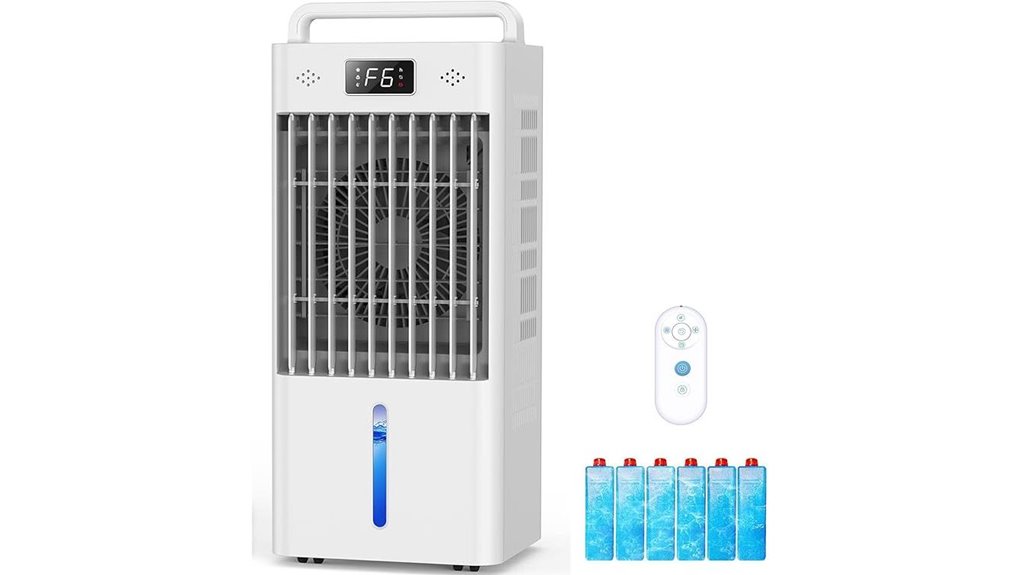
The in-1 Portable Evaporative Air Cooler with Remote is the best affordable pick for anyone who wants easy, plug-and-play cooling without installation hassles. You’ll power it up in seconds—no hoses, no windows, just place it where you need cooling and switch on. Its upgraded 2025 tech delivers dense cooling via water evaporation, with an energy-saving 65W motor and a 3-gallon tank that runs up to 20 hours per fill. Move it between rooms, and enjoy a remote control up to 16 feet, a clear LED display, and quiet operation. When water depletes, it auto-switches to fan mode for safety.
Best For: Anyone seeking an affordable, plug-and-play evaporative cooler with remote control for use across living rooms, bedrooms, or offices without any installation or hoses.
Pros:
- Easy setup: plug-and-play with no hoses, no window installation, and portable between rooms.
- Upgraded 2025 cooling tech with dense cooling pads and a 3-gallon tank for up to 20 hours per fill.
- Remote control up to 16 feet, clear LED display, and quiet operation for focused work or sleep.
Cons:
- Evaporative cooling effectiveness may depend on ambient humidity.
- Water-tedious maintenance like rinsing (if leakage occurs) and periodic cleaning of the filter/media.
- Only 65W motor; may be less powerful in very large spaces compared to traditional air conditioners.
Uthfy Portable Evaporative Cooler with Ice Packs, Remote
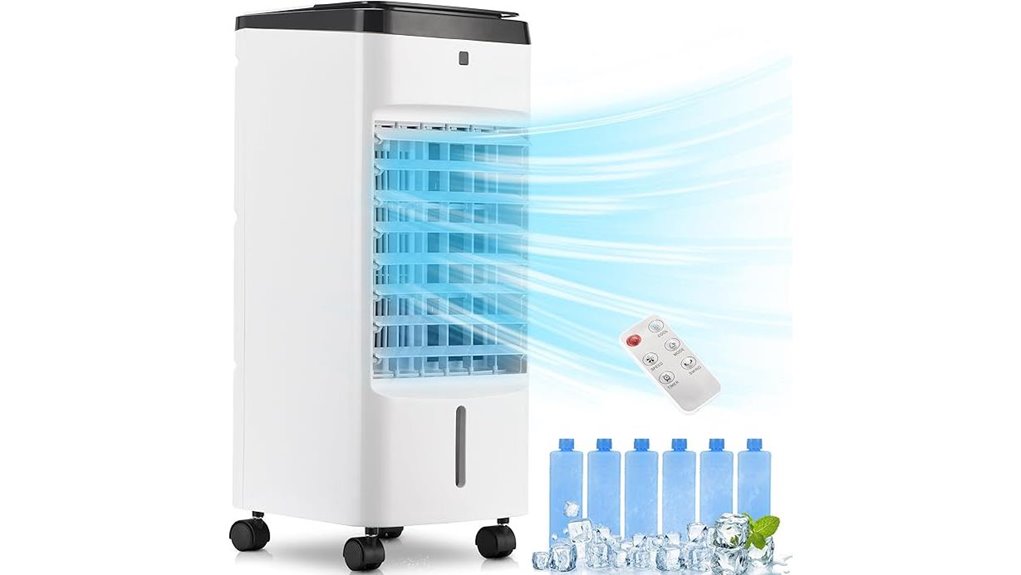
Looking for versatile budget cooling that doubles as a humidifier? The Uthfy Portable Evaporative Cooler is a 3-in-1 unit: fan, humidifier, and powerful evaporative cooler using ice packs for extra chill. It covers up to 500 sq ft with 360° distribution, delivers up to 22 ft/s airflow, and offers 3 speeds plus 4 modes. You control it remotely from up to 26 feet, and enjoy ultra-silent operation with a 12-hour timer. Detachable water tanks, 6 ice packs, and easy maintenance with a removable dust filter keep setup simple. Built for portability, it weighs 9.54 lb with wheels and handles. Warranty: 1 year.
Best For: Budget-conscious users seeking a versatile 3-in-1 evaporative cooler that also doubles as a humidifier for medium-sized rooms.
Pros:
- 3-in-1 functionality (fan, humidifier, evaporative cooler) with ice packs for enhanced cooling
- Remote control up to 26 feet, 12-hour timer, and ultra-silent operation
- Detachable water tanks, removable dust filter, and portability with wheels and handles
Cons:
- Evaporative cooling effectiveness depends on humidity and may be less effective in high-humidity environments
- Noise level listed as 25 decibels, which may still be noticeable on high speed
- Coverage up to 500 sq ft; performance may vary in larger or multi-room layouts
Uthfy 41″ Portable AC: 3-in-1, Oscillating fans
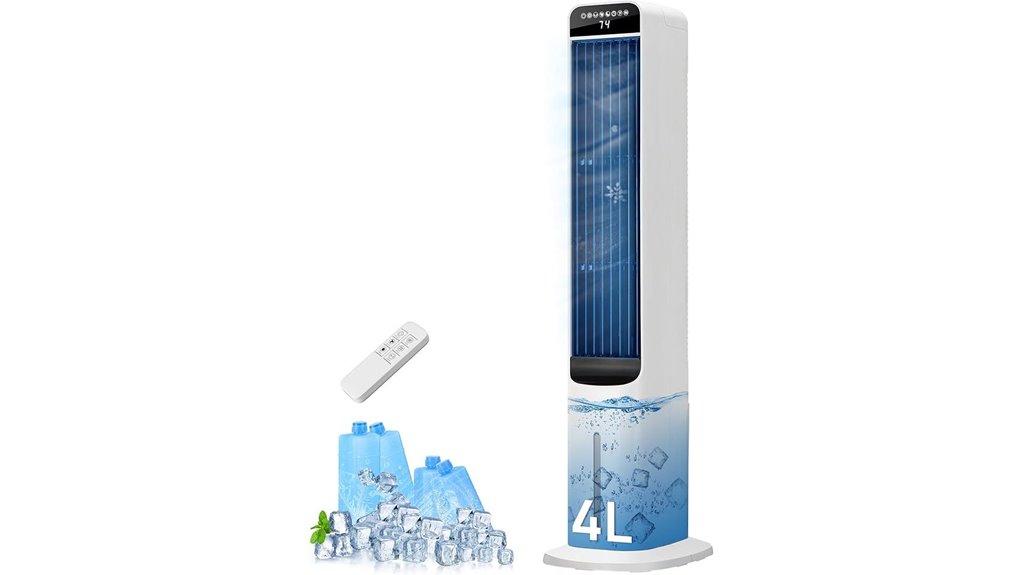
If you’re prioritizing a compact, versatile cooling solution for spaces over 300 square feet, the Uthfy 41″ Portable Air Conditioner stands out with its 3-in-1 evaporative design and a tall, freestanding tower that doubles as an oscillating fan. This 41-inch unit runs on 80 watts at 120 volts and weighs just 12.1 pounds, with a 12.4″ D x 8.24″ W x 39.57″ H footprint. It delivers up to 13,000 CFM across four modes—Normal, Natural, Sleep, Cool—and three speeds, with 120° oscillation. Features include a 4-liter detachable tank, ice packs, washable filter, remote, timer, and ultra-quiet Sleep mode. Warranty: 1 year.
Best For: Those seeking a tall, compact evaporative cooler that can cover large spaces (over 300 sq ft) with quiet operation and multiple modes.
Pros:
- 3-in-1 evaporative cooler with cooling, fan, and humidification capabilities in a 41″ freestanding unit
- Ultra-quiet Sleep mode under 25 dB and 120° oscillation for even air distribution
- 4-liter detachable water tank, ice packs, washable filter, and remote control for convenient use
Cons:
- Only 80 watts and evaporative cooling may require higher humidity environments to perform best
- Coverage claim of 300+ sq ft can vary with room conditions and may be less effective in very hot, dry climates
- Requires access to water and periodic refills; heavier maintenance than basic fans
Portable Rechargeable Mini AC with 2 Speeds for Small Rooms
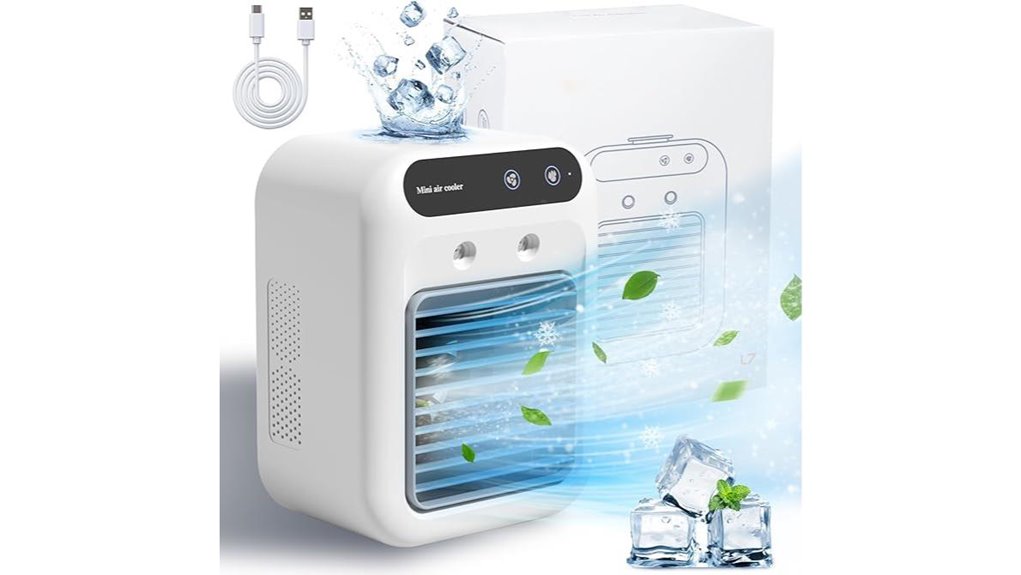
Small-room comfort on a budget lands here with the Portable Rechargeable Mini AC, a compact 25W unit that doubles as a mist humidifier and evaporative cooler, ideal for bedrooms, offices, and dorms. You get two speeds for targeted cooling, using ice and water for up to 10 hours at max spray, or about 8 hours overnight. It runs on a built-in battery via USB, or plugged in, with a 500ml tank and quiet operation around 20 decibels. No refrigerants—cooling and humidifying together—and it doubles as a personal desk cooler for year-round use. Brand Deller, Model XKT-B105, 0.1 kg.
Best For: Small-space users seeking an affordable, USB-powered, cordless cooling and humidifying solution for bedrooms, offices, dorms, or outdoor use.
Pros:
- Lightweight, compact design with a 500ml water tank for desktop cooling
- 25W energy usage with no refrigerants, dual function as cooler and humidifier
- Flexible power options (built-in battery, USB charging, plug-in) and quiet operation (~20 dB)
Cons:
- Suitable mainly for small rooms; limited airflow compared to larger AC units
- 0.1 kg weight noted in specs may be incorrect or inconsistent with typical product weight
- Requires regular water/ice replenishment for extended use and mist performance
Portable Air Conditioner: USB Desk Cooler with Mood Lighting
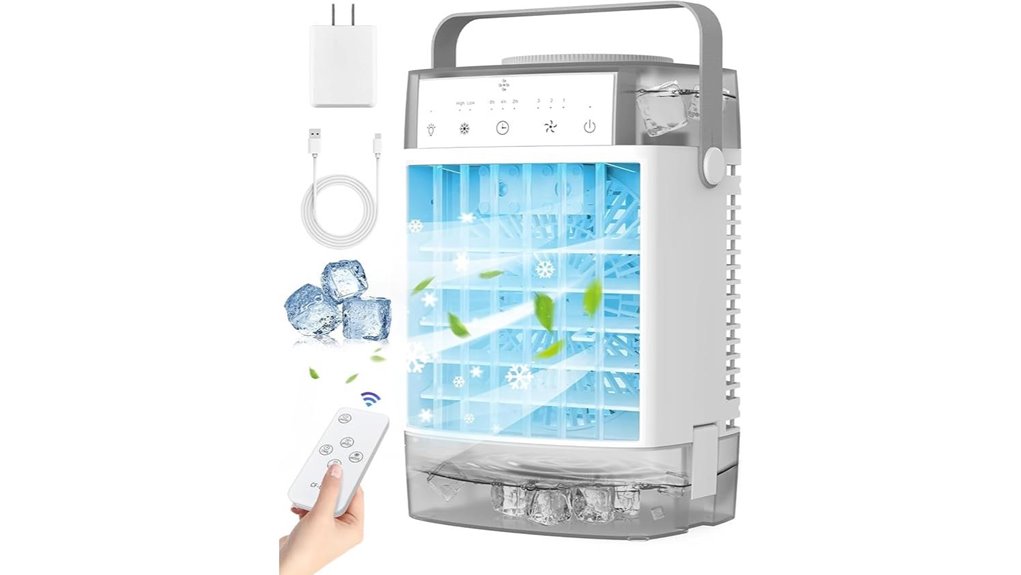
This USB Desk Cooler with mood lighting is the best pick for anyone wanting portable, plug-and-play cooling without installation. It’s a 3-in-1 device: air cooler, humidifier, and fan in one compact unit (8.5 L x 7.13 W x 12.28 H; 2.73 lbs). Evaporative cooling delivers a breeze, with 55 dB low noise and three wind speeds. Use it with water and ice in top tank for quick cooling, or humidify for longer relief. USB-C powered, works with power banks, laptops, car chargers, or a 5V/2A home adapter. Mood lighting and remote control enhance versatility.
Best For: Anyone seeking a portable, plug-and-play cooling solution for desks, bedrooms, or outdoor spaces without installation.
Pros:
- 3-in-1 device: air cooler, humidifier, and fan in one compact unit
- Low-noise operation (55 dB) with multiple wind speeds and mist modes
- USB-C powered and versatile Power options (power bank, laptop, car charger, or 5V/2A home adapter)
Cons:
- Small water tanks require more frequent refills for longer use
- Evaporative cooling effectiveness depends on humidity and ambient conditions
- Requires access to USB power or adapter; not suitable for non-electrical environments
Factors to Consider When Choosing Affordable Cooling Devices for Home
When you’re choosing affordable cooling devices, start by weighing energy-efficient options and their tank capacity or run time to match your space and schedule. Consider portability and setup ease, plus noise levels for comfort, so you don’t trade convenience for quiet operation. Finally, look at features and maintenance needs to balance performance with long-term value.
Energy-Efficient Cooling Options
Ever wondered how to stretch your cooling budget without sacrificing comfort? Energy-efficient options focus on low power draws and flexible use. Evaporative coolers sip power—roughly 60–80 watts—much less than traditional AC, so you get cooling without big spikes in your bill. Look for models with 3-in-1 functions (fan, humidifier, cooler) to tailor cooling needs and save energy when full blast isn’t required. Large-capacity water tanks extend runtime, cutting the number of times you refresh power supply and reducing electricity usage over time. Added features like remote controls, timers, and sleep modes optimize operation, letting you cool only when you need it. Quieter designs, often under 46 dB, boost comfort without extra energy costs.
Tank Capacity And Run Time
Tank capacity directly impacts how long you can run cooling between refills. A larger water tank generally extends runtime; for example, a 3-gallon capacity can provide up to about 20 hours of continuous cooling per fill. Keep an eye on visible water level indicators so you can monitor remaining runtime and plan refills without guesswork. Some units auto-switch to fan mode when the water runs out, preventing abrupt downtime and maintaining safety. Detachable or easily refillable tanks—top or pull-out designs—reduce downtime between uses. Ice packs or ice addition can temporarily boost cooling duration without refilling water. If you anticipate frequent use, prioritize units with clear indicators, simple refills, and options to extend time with ice for practical, budget-friendly cooling.
Portability And Setup Ease
Is portability a priority? You’ll notice these devices are designed for plug-and-play use with no permanent install, so you can set them up anywhere you need quick relief. Many units lean into portable design—think handheld, compact towers, or desktop footprints—with built-in wheels or handles that make relocation a breeze. Removable water tanks, typically 4 to 6 liters or more, and top or side refilling options simplify ongoing maintenance and setup, so you don’t juggle spills or leaks. Some models even offer USB-powered operation or battery/cordless use, boosting flexibility in rooms without steady outlets. Remote controls or simple panels let you operate from seats or beds, reducing repositioning while you cool.
Noise Levels And Comfort
When choosing an affordable cooling device, noise level and overall comfort matter as much as cooling power. Evaporative coolers offer a noise range from about 25 dB to 46 dB, with ultra-quiet modes around 25–30 dB suitable for sleep and study. Sleep or ultra-quiet modes are designed to minimize disturbance, often targeting single-digit to low tens dB. Quiet operation is commonly prioritized for office, bedroom, and study spaces, with some models advertising around 20–25 dB in low-speed settings. Higher wind speed or ice-pack cooling modes typically increase noise compared to fan-only or sleep modes, affecting comfort in quiet spaces. Noise performance is often paired with energy-saving features, aiming to balance cooling effectiveness with minimal acoustic disruption.
Features And Maintenance Needs
Smart design doesn’t stop at cooling power—look for units that combine fans, humidifiers, and coolers in one, so you can tailor humidity and airflow to your space. Many evaporative models offer 3-in-1 functionality, letting you add humidity or pure airflow as needed. For practical use, check how you’ll maintain them: monitor visible water levels, refill tanks (often about 0.5 to 3 gallons in tested units), and clean removable filters or curtains to keep efficiency high. Quiet operation helps during sleep or study, with ranges around 25–46 dB depending on mode. Convenience features matter, too: remote control, programmable timers, sleep modes, and auto shutoff improve ease of use and energy savings without sacrificing performance. Prioritize models with straightforward maintenance and flexible cooling options.
Common Questions
Do These Devices Require Professional Installation?
Installing them often isn’t required. You can usually set up many affordable cooling devices yourself with simple tools, following the quick-start guide. Portable fans, window units, and evaporative coolers typically don’t need professional help, while mini-split systems or ducted units may. If you encounter complex electrical work or refrigerant handling, hire a licensed pro. Think of it as a DIY-friendly upgrade, saving time and money while you stay cool and comfortable.
How Energy-Efficient Are These Cooling Options?
They’re fairly energy-efficient, especially newer models with Energy Star ratings and inverter tech. You’ll save more by choosing units with variable speed compressors, smart thermostats, and proper sizing for your space. Use fans to boost effectiveness, seal leaks, and maintain clean filters. Expect annual energy costs to drop compared to older units, but efficiency varies by type (ductless minisplits often outperform window ACs). Compare SEER/CER and running watts to estimate your exact savings.
What Maintenance or Filter Replacements Are Needed?
You’ll typically need to replace or clean filters every 1–3 months depending on usage and filter type. Check the user manual for target replacements, as HEPA or carbon filters last longer than basic fiberglass ones. Rinse or wipe down easy-access areas monthly to prevent dust buildup. For window units, vacuum coils and inspect seals yearly. Replace dehumidifier or evaporative pads as recommended, usually annually. Schedule professional HVAC checks seasonally for optimal performance.
Do They Work Effectively in High Humidity?
They do work, but high humidity can dull performance. You’ll notice more inefficiency as moisture challenges airflow and cooling capacity, so you might pair a dehumidifier with your unit. Keep filters clean, seals tight, and vents unblocked to maximize results. In humid rooms, expect slightly longer cooling times, but steady comfort with consistent settings. If you don’t see improvement, maybe upgrade to a model rated for humid climates or add a humidity-control device.
Are There Safety Concerns for Children and Pets?
Yes, there are safety concerns for children and pets. Keep cords out of reach, unplug devices when not in use, and supervise kids around fans, humidifiers, and portable AC units. Use stable placements to prevent tip-overs, avoid hot or sharp surfaces, and follow manufacturer instructions for cleaning to prevent mold or electrical hazards. Choose models with automatic shutoff, tip-resistant bases, and proper filtration. Regularly inspect for wear and replace damaged parts promptly.